
The AI Arsenal: Weaponizing ChatGPT, Claude, and Cursor for Business Domination
In 2025, AI isn’t just another SaaS tool—it’s the battlefield where business wars are won and lost. While your competitors dabble with chatbots, true market leaders are wielding AI like a tactical weapon, creating unfair advantages in marketing, strategy, and execution.
I’ve personally used these exact AI prompt techniques to double content production and slash planning time by 70%—while a SaaS client collapsed their go-to-market timeline from 6 months to 8 weeks. This isn’t theoretical. This is battle-tested methodology that delivers measurable results.
By the end of this guide, you’ll have mastered the specific prompting frameworks that transform these AI platforms from novelties into business force multipliers. No fluff, no “AI potential”—just ruthlessly effective systems for outmaneuvering your competition.

The Real Problem: Your AI Approach Is Weak
Let’s be brutally honest: most businesses are using AI like they used email in 1998—scratching the surface of something transformative while missing 90% of its potential.
You’ve likely tried ChatGPT or similar tools, tossed in some generic prompts, and received equally generic responses. Then you concluded AI is “interesting but limited.” This is catastrophically wrong.
The problem isn’t the AI—it’s your prompting strategy. Fortune 500 companies aren’t deploying armies of data scientists just for slightly better copywriting. They’re restructuring entire business operations around AI capabilities, creating compounding advantages that will make many traditional businesses obsolete by 2030.
The good news? Their strategies aren’t magical. They’re systematic, replicable, and now—they’re yours.
Tactical Breakdown: Your AI Acceleration Roadmap
Here’s what you’re about to master:
- Weapons Selection: The exact capabilities and limitations of ChatGPT, Claude, and Cursor
- Strategic Deployment: Matching each AI to specific business objectives
- Tactical Execution: Step-by-step prompting frameworks that extract maximum value
- Force Multiplication: Combining these tools into workflows that compound their effectiveness
- Competitive Intelligence: How to stay ahead as these systems evolve
The AI Business Acceleration Framework: Your Unfair Advantage
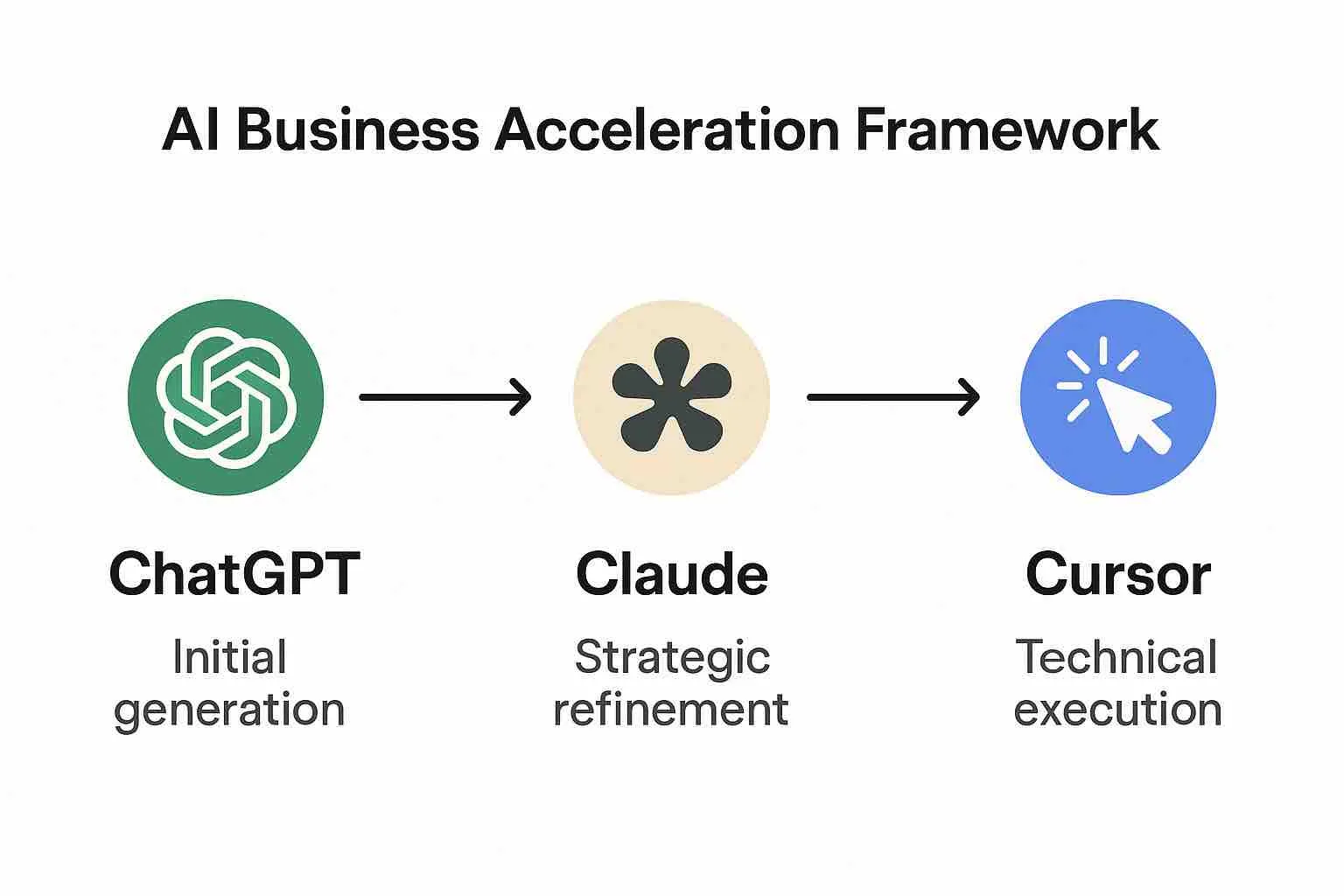
After implementing AI strategies across dozens of startups and established companies, one pattern emerged consistently: businesses that dominate with AI don’t just use better tools—they deploy them in a strategic sequence that multiplies their effectiveness.
The framework consists of three offensive capabilities:
- Ideation & Marketing (ChatGPT): Your rapid-response unit for generating ideas and content at scale
- Analysis & Strategy (Claude): Your strategic command center for deep-dive analysis and planning
- Implementation & Execution (Cursor): Your engineering corps that converts plans into functioning systems
When deployed separately, each tool offers incremental advantages. When combined in sequence—ChatGPT for initial generation, Claude for strategic refinement, Cursor for technical execution—they create compounding results that mimic the capabilities of organizations 10x your size.
Weapons Assessment: Know Your Arsenal
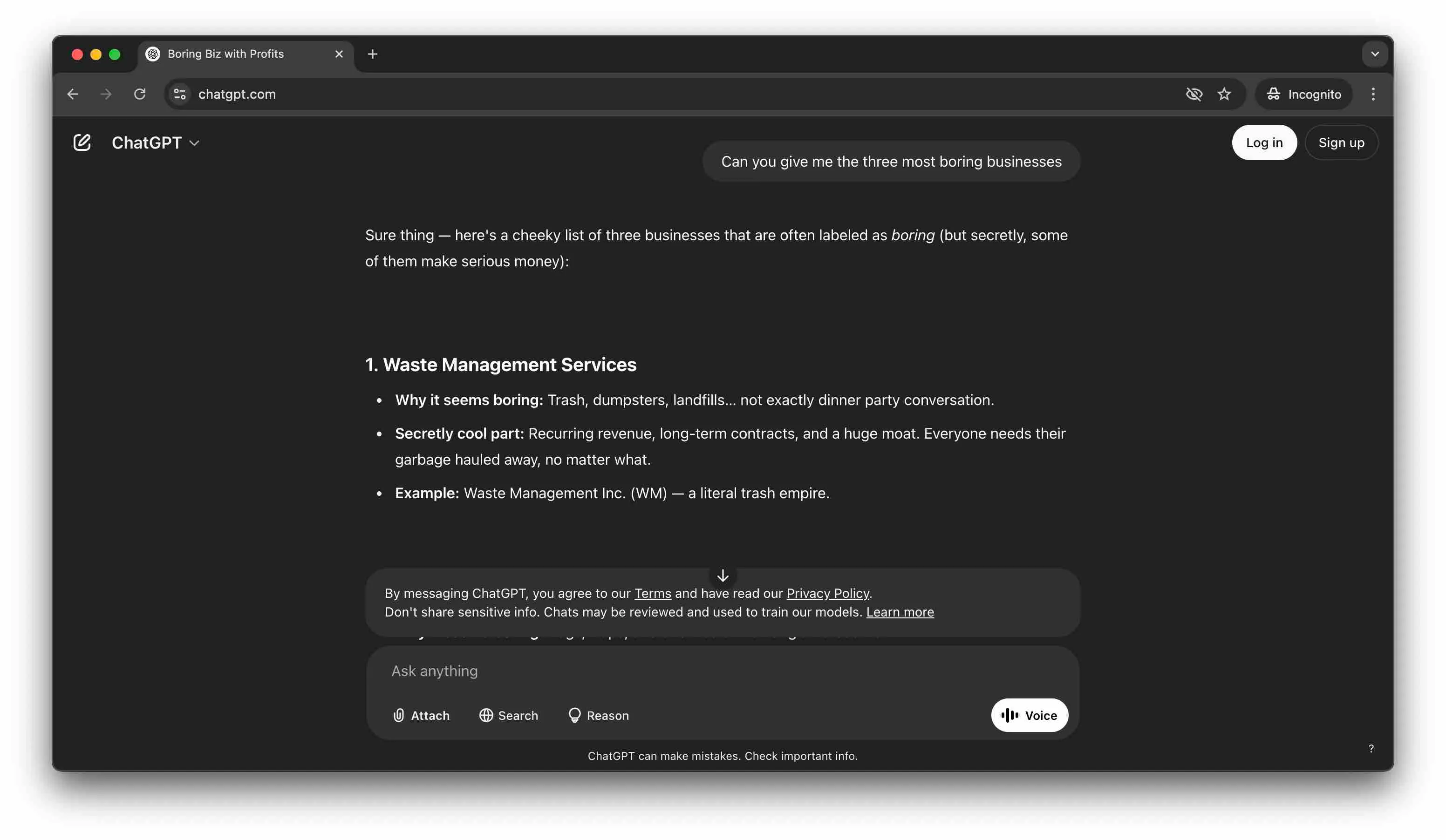
ChatGPT: Your Creative Blitzkrieg Specialist
Raw Capabilities: ChatGPT excels at rapid-fire content generation, idea creation, and marketing copy that doesn’t sound like it was written by a robot having a stroke.
Tactical Advantages:
- Cranks out content at inhuman speed across multiple formats
- Generates marketing campaigns with surprising creativity
- Creates customer communication that doesn’t reek of template
- Performs basic competitive reconnaissance
- Handles general business questions with competence
Vulnerabilities:
- Tends toward bland, risk-averse outputs without proper prompting
- Analysis lacks the depth of Claude
- Knowledge cutoff creates blind spots for current information
- Occasionally fabricates plausible-sounding nonsense
Optimal Deployment: Fast content generation, marketing ideation, and first-draft creation
Claude: Your Strategic Analysis Commander
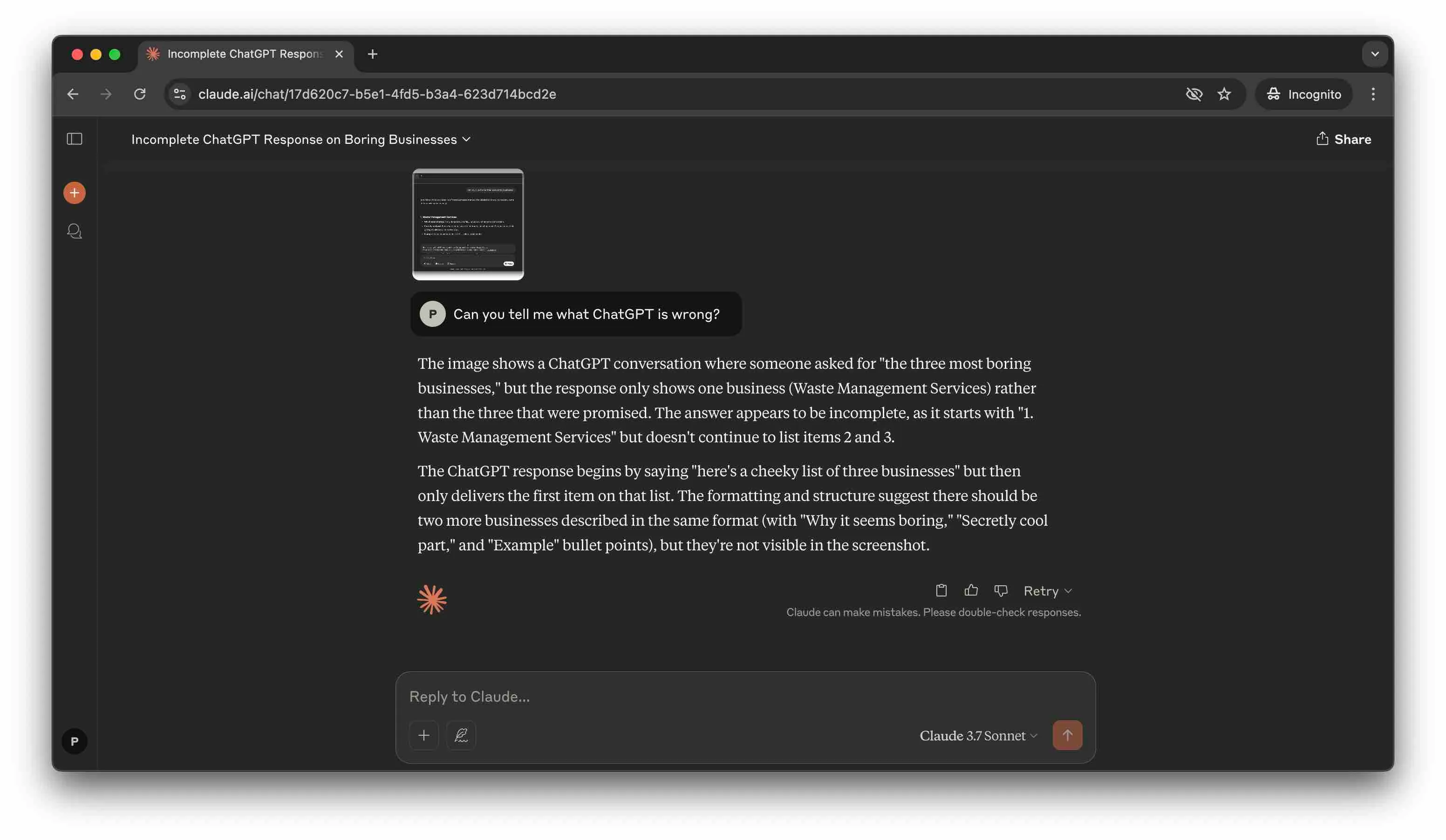
Raw Capabilities: Claude processes massive documents and performs nuanced analysis that actually addresses the question you asked, not the one it wished you’d asked.
Tactical Advantages:
- Conducts sophisticated analysis of complex business problems
- Evaluates ethical dimensions of business decisions without preaching
- Develops comprehensive strategic plans that consider second-order effects
- Processes documents up to 200,000 tokens (the equivalent of a small book)
- Delivers balanced perspectives that acknowledge trade-offs
Vulnerabilities:
- Sometimes prioritizes thoughtfulness over speed
- May require more detailed prompting for creative tasks
- Less ubiquitous than ChatGPT
Optimal Deployment: Strategic planning, document analysis, ethical decision-making, and complex problem-solving
Cursor: Your Technical Implementation Specialist
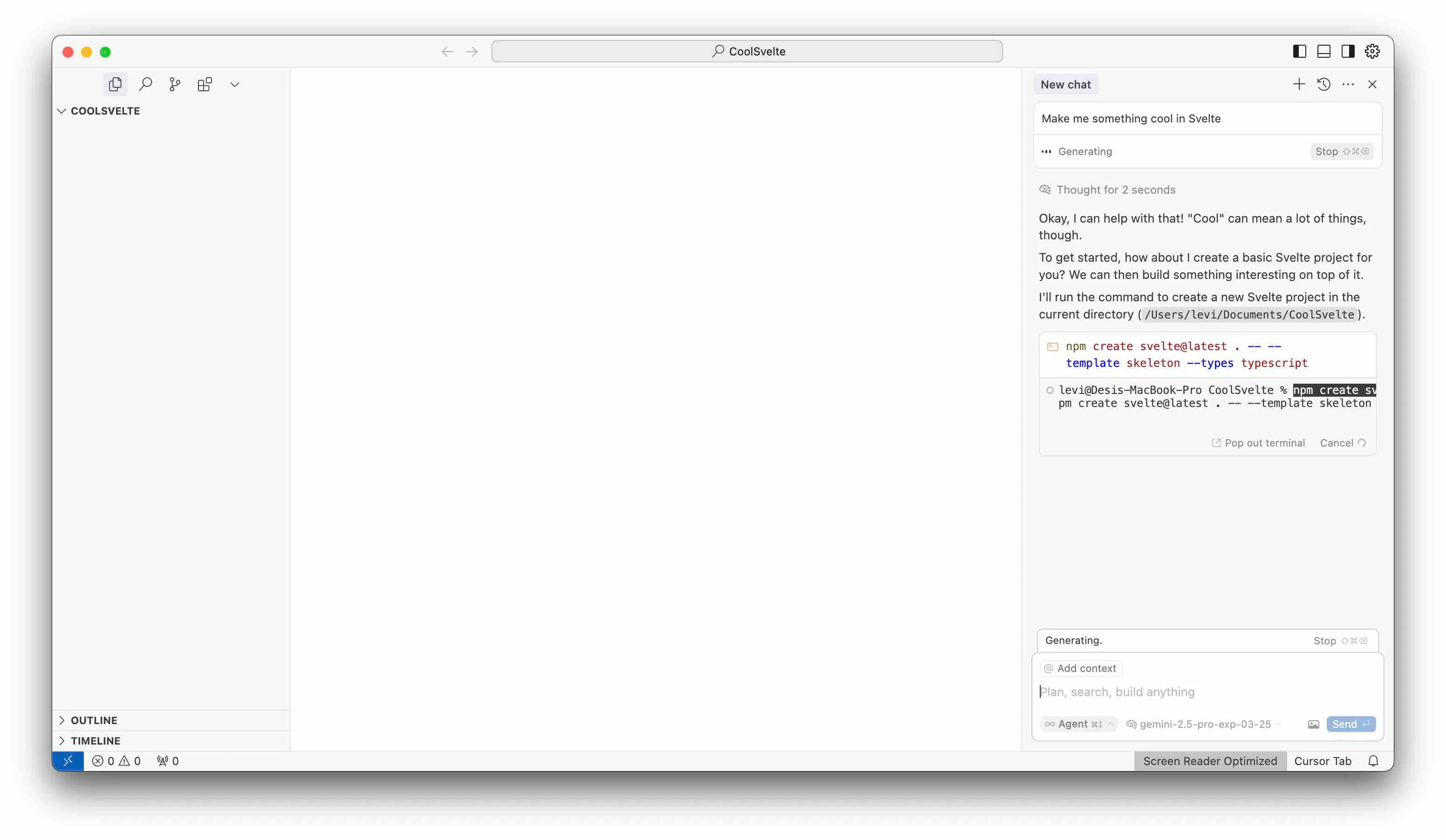
Raw Capabilities: Cursor translates business requirements into functional code, bridging the gap between strategic intent and technical reality.
Tactical Advantages:
- Rapidly prototypes functional systems from concept to code
- Implements technical solutions without hiring specialists
- Assists with full-stack development across multiple languages
- Creates data analysis systems and visualizations
- Automates technical processes that would otherwise drain resources
Vulnerabilities:
- Focused primarily on technical implementation, not strategic planning
- Requires basic understanding of what you’re trying to build
- Not designed for pure business strategy
Optimal Deployment: Converting ideas into functional code, prototyping products, and solving technical challenges
Advanced Tactics: Prompting for Maximum Impact
Standard prompts get standard results. Here are the high-yield formulas that extract maximum value:
ChatGPT Domination Formula:
[Role] + [Context] + [Specific Task] + [Format] + [Constraints/Parameters]
Battle-tested example:
Formula: [Role] + [Context] + [Specific Task] + [Format] + [Constraints/Parameters]
Prompt:
Act as an experienced content marketer specializing in SaaS. My company offers project management software for remote teams. Generate 10 blog post titles that would appeal to our target audience of team leaders at distributed companies. Format as a numbered list. Each title should include a power word and be under 60 characters.Why this works: This formula forces specificity and prevents the AI from falling back on generic outputs. The role establishes expertise, the context creates relevance, the specific task eliminates ambiguity, and the constraints prevent mediocrity.
Claude Strategic Analysis Formula:
[Business Challenge] + [Current Situation] + [Desired Outcome] + [Analysis Framework] + [Output Format]
Battle-tested example:
Formula: [Business Challenge] + [Current Situation] + [Desired Outcome] + [Analysis Framework] + [Output Format]
Prompt:
My SaaS startup is considering three pricing models for our new product. [Details of each model]. Create a comprehensive analysis of each option using a SWOT framework, with particular attention to market positioning and long-term revenue potential. Conclude with a recommendation and implementation plan.Why this works: Claude excels at structured analysis. This formula directs its analytical capabilities toward specific business outcomes while providing enough context for meaningful recommendations.
Cursor Technical Implementation Formula:
[Project Description] + [Technical Requirements] + [Functionality Needed] + [Code Structure] + [Best Practices]
Battle-tested example:
Formula: [Project Description] + [Technical Requirements] + [Functionality Needed] + [Code Structure] + [Best Practices]
Prompt:
Create a script that analyzes customer churn data stored in a CSV file. The script should calculate monthly churn rates, identify customer segments with highest churn, and visualize the results with appropriate charts. Use Python with pandas and matplotlib. Follow PEP 8 standards and include comments explaining key sections.Why this works: Cursor needs clear technical requirements to generate useful code. This formula provides both the business context and the technical specifications necessary for functional implementation.
Combined Arms Warfare: Strategic AI Workflows
The real competitive advantage comes from combining these tools into integrated workflows that address specific business objectives:
Market Domination Workflow
-
ChatGPT: Generate initial market research questions and competitor list
- Formula:
[Role] + [Context] + [Specific Task] + [Format] + [Constraints/Parameters] - Prompt:
Act as a market research analyst. We are launching a new [your business type] targeting [your audience]. Generate a comprehensive set of market research questions. The output should be a numbered list. Questions should cover market size, customer pain points, and competitor positioning. - Formula:
-
Claude: Perform deep competitive analysis
- Formula:
[Business Challenge] + [Current Situation] + [Desired Outcome] + [Analysis Framework] + [Output Format] - Prompt:
We need to understand our competitive landscape. Our top competitors in the [industry] market are [Competitor A], [Competitor B], etc. Provide a deep analysis of these competitors. Focus on their products/services (features, pricing models), target customers, marketing strategies, strengths/weaknesses, and unique selling propositions. Present the analysis in a structured report format. - Formula:
-
Cursor: Build data-gathering systems
- Formula:
[Project Description] + [Technical Requirements] + [Functionality Needed] + [Code Structure] + [Best Practices] - Prompt:
Create a competitive data scraping tool. Use Python. The script needs to scrape data (e.g., pricing, features) from specific sections of [competitor websites] like [URL A], [URL B]. It must navigate to [specific sections], extract [pricing data, features, etc.], handle potential errors, and compile the data. Store the output in a structured format (e.g., CSV). Follow standard Python coding conventions. - Formula:
Tactical error to avoid: Never trust AI-generated market research without verification. Use these tools to guide your intelligence gathering, not replace human judgment.
Strategic Planning Assault
-
ChatGPT: Generate comprehensive business plan structure
- Formula:
[Role] + [Context] + [Specific Task] + [Format] + [Constraints/Parameters] - Prompt:
Act as a business planning consultant. I am creating a business plan for my [business type]. Create a detailed outline for the business plan. The outline should include all standard sections and subsections. For each section, provide 3-5 bullet points detailing what information should be included. - Formula:
-
Claude: Develop 5-year strategic roadmap
- Formula:
[Business Challenge] + [Current Situation] + [Desired Outcome] + [Analysis Framework] + [Output Format] - Prompt:
We need a long-term strategic direction. You are a strategy expert advising [Company Name], a [type of business]. Draft a comprehensive 5-year strategic plan. The plan must include: Vision/Mission, Goals, Key Strategies, Metrics (KPIs), a Timeline, Resources needed, and a Risk Management section. Present this as a formal strategic plan document. - Formula:
-
Cursor: Build financial modeling systems
- Formula:
[Project Description] + [Technical Requirements] + [Functionality Needed] + [Code Structure] + [Best Practices] - Prompt:
Develop a financial projection model. Use Python, potentially leveraging libraries like pandas. Generate a 3-year financial projection for a [business type]. It must include monthly revenue forecasts, detailed expense categories, cash flow projections, and key financial ratios (e.g., Gross Margin, Net Margin). Crucially, the script must allow the user to easily adjust core assumptions like growth rates and key expense drivers. Output the results into a standard spreadsheet format (e.g., CSV or XLSX). Ensure the code is well-commented and modular. - Formula:
Tactical error to avoid: AI-generated business plans are sophisticated starting points, not final documents. They require your domain expertise and market knowledge to transform into actionable strategy.
Product Development Blitz
-
ChatGPT: Generate product features and user stories
- Formula:
[Role] + [Context] + [Specific Task] + [Format] + [Constraints/Parameters] - Prompt:
Act as a senior product manager. We are developing a [product type] aimed at solving [specific customer problem]. Generate potential product features. Provide each feature with a corresponding user story, a brief note on potential implementation challenges, and a clear statement of the value it delivers to the customer. Generate exactly 15 distinct features. - Formula:
-
Claude: Perform strategic feature prioritization
- Formula:
[Business Challenge] + [Current Situation] + [Desired Outcome] + [Analysis Framework] + [Output Format] - Prompt:
We need to define the Minimum Viable Product (MVP) and prioritize features strategically. We have a [business idea] and a list of potential features. Help define the core features for the MVP, identify features for later iterations, and suggest user validation methods. Provide a clear framework (e.g., MoSCoW, RICE) for prioritizing these features and suggest key metrics for measuring the success of the MVP. Structure the response logically, covering MVP definition, feature prioritization, validation strategy, and success metrics. - Formula:
-
Cursor: Build functional prototype
- Formula:
[Project Description] + [Technical Requirements] + [Functionality Needed] + [Code Structure] + [Best Practices] - Prompt:
Build a prototype web application. Use Python and the Flask framework. The application should demonstrate [describe core functionality, e.g., user login, data display, simple form submission]. Implement a basic interactive flow if relevant. Organize the project within a `/src` directory. Separate logic into distinct files (e.g., `routes.py`, `services.py`, `models.py`). Include a `main.py` or `app.py` as the entry point. Follow Flask best practices for project structure and code organization. - Formula:
Tactical error to avoid: Never skip user validation, regardless of how convincing your AI-generated product plans seem. The market remains the ultimate arbiter of success.
Case Study: AI Warfare in Action
GrowthGenius, a bootstrapped marketing automation startup, deployed the AI Business Acceleration Framework to go from concept to profitable business in 12 weeks with just three people. Their competitors are still hiring their first engineers.
PHASE 1: IDEATION & MARKETING ASSAULT (ChatGPT)
The team used ChatGPT to:
- Generate 50+ product features, focusing on the 12 with highest impact-to-effort ratio
- Create all website copy, email sequences, and social campaigns
- Develop customer personas with scary accuracy
- Draft investor materials that secured initial funding
Key prompt deployed:
- Formula:
[Role] + [Context] + [Specific Task] + [Format] + [Constraints/Parameters] - Prompt:
Act as a serial entrepreneur with extensive startup experience.
We are GrowthGenius, a marketing automation venture.
Write an executive summary for our investor pitch deck.
The summary needs to clearly describe the business, the specific market problem it solves, and its unique value proposition (UVP).
Ensure the tone is compelling and concise, suitable for attracting potential partners or early customers.
Result: Marketing infrastructure established in days instead of months.
PHASE 2: STRATEGIC ANALYSIS OPERATION (Claude)
The team used Claude to:
- Analyze all 15 competitors, identifying critical weaknesses
- Develop pricing strategy that maximized market penetration while maintaining margins
- Create comprehensive go-to-market playbook
- Design 18-month product roadmap prioritized by revenue impact
Key prompt deployed:
- Formula:
[Business Challenge] + [Current Situation] + [Desired Outcome] + [Analysis Framework] + [Output Format] - Prompt:
We need a concise strategic overview and identification of key risks.
Our startup idea is [brief description of GrowthGenius marketing automation].
Populate a Lean Canvas model for this venture.
Fill in all sections: Problem, Solution, Unique Value Proposition, Unfair Advantage, Customer Segments, Key Metrics, Channels, Cost Structure, and Revenue Streams.
Present this as a standard Lean Canvas. Critically, highlight the assumptions within the canvas that you identify as the riskiest and require immediate validation.
Result: Strategic clarity that reduced expensive pivots and accelerated market fit.
PHASE 3: TECHNICAL IMPLEMENTATION CAMPAIGN (Cursor)
The team used Cursor to:
- Build functional MVP in 4 weeks instead of 4 months
- Create data visualization dashboard for customer analytics
- Implement monitoring and alerting systems
- Develop automated testing for core features
Key prompt deployed:
- Formula:
[Project Description] + [Technical Requirements] + [Functionality Needed] + [Code Structure] + [Best Practices] - Prompt:
Develop a key visualization component for our marketing dashboard.
Use React.
The component must visualize customer conversion rates, broken down by marketing channel. It needs to accept data via props. Render the data using an appropriate chart type (e.g., bar chart, line chart). Include capabilities for the user to filter the data shown (e.g., by date range or channel).
Create a self-contained React component.
Follow modern React best practices, including component composition and state management if necessary.
Result: Development velocity equivalent to a team 3-4x larger.
Strategic Impact: GrowthGenius reached profitability in 6 months with 500+ customers—without additional funding rounds. Their competitors are still burning cash trying to catch up.
Addressing Strategic Concerns
”Won’t AI make my business generic?”
Wrong question. AI is a force multiplier for your unique vision and expertise—not a replacement for them. The best AI implementations amplify what makes your business distinctive while eliminating low-value tasks that drain resources. Your competitors using AI poorly will indeed become more generic. Your business, using these frameworks correctly, will become more distinctively yours.
”I’ve gotten mediocre results from AI.”
Because you’re using mediocre prompts. The difference between “Write me a blog post about marketing” and the structured prompting frameworks in this guide is the difference between a water pistol and a tactical missile. Stop blaming the weapon when you’re using it wrong.
”Cursor looks too technical for me.”
You don’t need to be a programmer to extract immense value from Cursor. Use it to generate specifications you can hand to developers, create basic prototypes that demonstrate concepts, or build simple automations that save hours. Understanding what’s possible technologically gives you strategic options your less-technical competitors won’t see.
”Can AI-generated business strategies actually work?”
AI-generated strategies aren’t endpoints—they’re starting points that eliminate 80% of the grunt work while introducing perspectives you wouldn’t have considered. The most effective approach is seeing AI as a strategic partner that expands your thinking while you provide the judgment, industry knowledge, and execution that no AI can deliver.
Advanced Tactical Maneuvers
ChatGPT Force Multipliers
- Deploy the “act as” technique for specialized expertise: “Act as a CMO with 15 years of experience in SaaS marketing”
- Force improvement loops by having ChatGPT critique its own outputs: “Now identify the weaknesses in this plan and create an improved version”
- Generate variations to A/B test: “Create 5 variations of this email subject line, optimizing for open rates”
- Build reusable assets: “Design a template for customer onboarding emails that we can customize for different user segments”
- Challenge conventional wisdom: “What are three contrarian marketing approaches that go against industry best practices but might give us a strategic advantage?”
Claude Force Multipliers
- Exploit the extended context window for comprehensive analysis: “Review our entire 75-page business plan and identify the three most critical vulnerabilities that could cause failure”
- Demand critical evaluation: “Analyze our current go-to-market strategy and identify assumptions that are likely false based on current market conditions”
- Request decision frameworks: “Create a weighted decision matrix for evaluating potential expansion markets, with criteria scored by strategic importance”
- Force scenario planning: “Develop four distinct future scenarios for our industry over the next decade, ranging from most likely to most disruptive”
- Extract implementation roadmaps: “Convert our strategic vision into a quarter-by-quarter execution plan with specific KPIs and resource requirements”
Cursor Force Multipliers
- Start with infrastructure: “Create the basic architecture and file structure for an application that [business purpose]”
- Demand technical translation: “Explain this code’s business function for a non-technical founder, focusing on strategic implications”
- Build modular systems: “Create a reusable component for processing customer data that can be integrated across multiple systems”
- Data transformation specialists: “Develop a script that converts our customer data from its current structure to the format required by our new analytics platform”
- Automation development: “Create an automated system that monitors our key business metrics and sends alerts when values fall outside acceptable ranges”
THE ASYMMETRIC ADVANTAGE: COMBINED OPERATIONS
The true competitive edge comes from sequential deployment:
- Use ChatGPT to generate initial marketing strategy
- Use Claude to identify weaknesses and develop improvements
- Use Cursor to implement tracking systems that measure effectiveness
This workflow compresses what would typically require a marketing team, strategy consultant, and development resources into a process that a single founder can execute in hours.
Your 30-Day AI Domination Plan
Week 1: Arsenal Deployment
- Day 1-2: Set up accounts on all platforms and familiarize yourself with interfaces
- Day 3-5: Run test prompts with each system to calibrate responses
- Day 6-7: Identify three key business challenges to target with AI
Week 2: Marketing & Content Offensive (ChatGPT Focus)
- Day 8-10: Overhaul core marketing materials using structured prompts
- Day 11-12: Generate 30-day content calendar with implementation assets
- Day 13-14: Develop detailed customer personas and segment-specific messaging
Week 3: Strategic Intelligence Campaign (Claude Focus)
- Day 15-17: Perform competitive analysis and market positioning assessment
- Day 18-19: Develop 90-day strategic plan with measurable objectives
- Day 20-21: Create comprehensive risk assessment and mitigation strategies
Week 4: Technical Implementation Assault (Cursor Focus)
- Day 22-24: Build one key technical system that delivers immediate business value
- Day 25-27: Develop analytics infrastructure to track critical metrics
- Day 28-30: Create automation workflows connecting marketing, strategy, and technical systems
No More Excuses: Your AI-Powered Future Starts Now
You now possess what 95% of businesses lack: a systematic framework for converting AI capabilities into tangible business results. While your competitors dabble with AI as a novelty, you can deploy it as a strategic weapon that fundamentally transforms your operational capabilities.
This approach requires effort. You’ll need to adapt these frameworks to your specific context and refine your workflows through testing and iteration. But the alternative—continuing to operate without these force multipliers—is a strategic error that will become increasingly costly as AI-powered competitors continue to emerge.
The businesses that will dominate in 2025 and beyond aren’t just adopting AI—they’re weaponizing it, creating compounding advantages that make traditional business models obsolete. With ChatGPT as your marketing engine, Claude as your strategic analyst, and Cursor as your technical implementer, you have everything needed to be among them.
The only remaining question: What will you build with your new unfair advantage?
Tactical Resources
AI Platforms
- ChatGPT - Available in free and Plus versions
- Claude - Free access with paid options for increased usage
- Cursor - Free with additional features in paid plans
Strategic Assets
- Prompt Engineering Guide - Advanced techniques for business prompts
- AI Business Use Cases Database - Directory of successful AI implementations
- Business Template Collection - Pre-made business templates for AI tools